


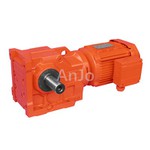
BLDC Worm Gear Motor
BLDC Worm Gear Motor
A BLDC worm gear motor is a power transmission device that integrates a brushless DC motor and a worm gear reducer. Its core functionality lies in the meshing of the worm wheel and worm, achieving speed reduction and torque increase, as well as 90° power steering. It also combines the low loss and long lifespan advantages of brushless motors with the inherent self-locking characteristics of the worm gear structure, making it suitable for various scenarios requiring stable positioning.
Features
- Self-locking and reliable positioning: This is one of its key advantages. After a power outage, the worm gear cannot reverse the worm, ensuring the load remains stably in its current position without the need for additional braking devices. This makes it particularly suitable for lifting and tilting equipment.
- Flexible steering and adaptability to compact spaces: The worm gear transmission directly changes the direction of power without requiring additional transmission components. Furthermore, the reducer has a compact structure and controllable overall size, making it suitable for small installation spaces requiring vertical power output.
Applications
Automated Equipment:
Vertical Lifting Mechanisms: such as lifts, electric hoists, and curtain motors. Self-locking features prevent the load from falling during power outages, ensuring safety.
01
Rotation Mechanisms:
Robot rotary platforms, radar antennas, and rotary worktables. Self-locking functions allow for precise positioning and locking at any location.
02
Valve Control:
Used to control ball valves, butterfly valves, etc. Self-locking functions ensure that the valve opening remains unchanged after power failure, eliminating the need for additional brake devices.
03
Stage Machinery:
Lighting rigging rods and scenery lifts. Safety self-locking is a primary consideration.
04
Medical Equipment:
Mechanisms requiring positional stability, such as hospital bed lifts and operating table adjustments.
05
FAQ
Q1: What key parameters should I consider when selecting a motor for my application?
A: Voltage and Speed: Determine the motor's rated voltage (e.g., 24V, 48V DC) and the required output speed.
Torque Requirements: Determine the rated torque and maximum torque required by the load. Worm gear mechanisms can provide high torque output.
Reduction Ratio: Determine the reduction ratio based on the motor speed and the required output speed. A single-stage worm gear mechanism can achieve a large reduction ratio.
Installation Space and Method: Consider the installation space, especially the vertical layout of the input and output shafts. Pay attention to the installation position (vertical installation is more prone to insufficient lubrication and wear).
Q2: How to extend the service life of a BLDC Worm Gear Motor?
A: Avoid prolonged overload and frequent start-stop cycles to reduce mechanical stress and commutation shocks; use a regulated power supply or surge protector to ensure stable power supply and prevent voltage fluctuations from damaging components; install protective devices in humid, high-temperature, or corrosive environments; regularly check winding insulation resistance and sensor signals, address any problems promptly, and use original factory parts whenever possible during maintenance.
Q3: What precautions should be taken for long-term storage?
A: It should be placed in a dry and ventilated environment to avoid moisture causing the windings to become damp and the metal parts to rust; anti-rust oil and grease can be applied to the bearings and gear meshing parts; it is recommended to power it on once every 3 months during long-term storage to prevent oxidation of the Hall sensor pins and aging of internal components, and to ensure that it can start normally when used again.
