


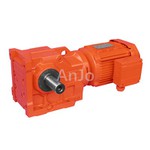
DC Brush Worm Gear Motor
DC Brush Worm Gear Motor
A DC brushed worm gear motor is an integrated power device that combines the power output of a DC brushed motor with a worm gear transmission mechanism. Its core function is to provide power through the motor, and then change the speed and torque of the power and adjust the transmission direction through the worm gear mechanism. It is suitable for transmission scenarios that require low speed and high torque.
Features
Low speed, high torque:
Ideal for scenarios requiring strong force and slow movement.
01
Self-locking:
Automatically maintains position after power failure, eliminating the need for additional braking devices. This is one of its core advantages.
02
Compact structure:
Integrates the motor and reducer into a single housing, saving space.
03
Simple control:
Easily controlled and speed-adjusted using a simple DC power supply or PWM (Pulse Width Modulation) signal.
04
Lower cost:
More cost-effective compared to servo motor or stepper motor systems.
05
Applications
- Electric curtains, electric doors and windows, and smart door locks in smart homes;
- Small conveying equipment and lifting platforms in small mechanical equipment;
- Small rehabilitation equipment in medical devices;
- Printer paper feeding mechanisms in office equipment.
FAQ
Q1: What key parameters should be considered when selecting a motor?
A: The main points to consider are:
Operating Voltage: Such as 12V, 24V, etc., which determines the motor's rated operating point.
Reduction Ratio: Such as 10:1, 30:1, 50:1, etc. A higher ratio results in a lower output speed and higher torque.
Rated Load Torque: The maximum torque the motor can safely output during continuous operation (unit: N.m or kg.cm).
No-Load Speed: The speed at which the output shaft is unloaded under rated voltage (unit: RPM).
Installation Dimensions and Output Shaft Type: Ensure the motor can be installed mechanically.
Q2: Does it require maintenance?
A: It requires limited maintenance.
Most importantly, replace the brushes (if the design allows) when they reach the end of their lifespan (manifested as increased sparking and unstable speed).
For heavy-duty applications, the grease in the gearbox may need to be checked or replaced periodically.
In most cases, it is designed to be "maintenance-free" until it fails and needs replacement.
Q3: How to choose between brushed and brushless DC worm gear motors?
A: If your budget is limited and the application scenario doesn't have extremely high lifespan requirements (such as ordinary household appliances), choose a brushed model, as it has a simple structure, low cost, and is easy to control. However, if it's used in scenarios requiring long-term continuous operation (such as small industrial conveyor lines), or if noise and lifespan requirements are high (such as precision medical devices), then a brushless model is more suitable. Brushless models don't have the problem of brush wear, have a longer lifespan, and lower noise, but they are more expensive and have higher control complexity.
Q4: Can a motor be started and stopped frequently?
A: Yes, but frequent starts and stops will accelerate the wear of the brushes and commutator, increase the impact load on the transmission mechanism, and shorten the lifespan of components. If the application requires high-frequency start and stop (such as automatic door locks), it is recommended to choose brush materials with better wear resistance and shorten the maintenance cycle.
