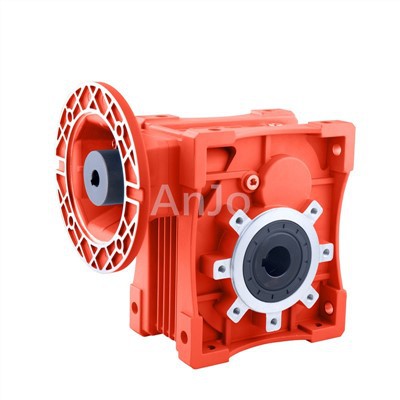
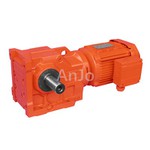
Bevel Gearbox
Bevel Gearbox
A bevel gearbox is a device that transmits power from one shaft to another using bevel gears. Its key characteristic is that the axes of these two shafts typically intersect at a 90-degree angle at a single point. Of course, other angles (such as 45° and 60°) exist, but 90° is the most common form.
Features
Changing the direction of transmission:
This is its most core and irreplaceable function, enabling right-angle transmission, saving space, and optimizing mechanical layout.
01
Compact structure:
In applications requiring right-angle transmission, its structure is typically more compact than other methods (such as worm gears or parallel shafts with couplings).
02
High transmission efficiency:
Especially with spiral bevel gears, the tooth surface contact is excellent, resulting in smooth transmission and high efficiency (typically exceeding 95%-98%).
03
High torque transmission:
A well-designed bevel gearbox can withstand and transmit large torques.
04
Speed-changing function:
By adjusting the gear ratio between the driving and driven gears, speed reduction and torque increase can be achieved.
05
Applications
- Agricultural machinery: Power transmission systems for tractors and harvesters.
- Industrial equipment: Mixers, winches, conveyor lines, packaging machinery, steel rolling mills, and any application requiring a change in power direction.
- Wind power generation: Used to transmit the power of a horizontally rotating wind turbine to a vertically placed generator.
- Construction machinery: Steering and working devices of loaders and excavators require bevel gearboxes to change the power direction of hydraulic motors or engines.
- Machine tools: The spindles or feed systems of some machine tools require bevel gearboxes to adjust the power transmission path to adapt to processing requirements.
- General machinery: Such as mixers and conveyors, where bevel gearboxes are used when the motor's mounting direction is inconsistent with the rotation direction of the working parts.
FAQ
Q1: How to choose the right bevel gearbox based on your needs?
A: Three core parameters: First, the transmission ratio, which must match the input and output speed and torque requirements; second, the steering angle, to determine whether 90° or other angle transmission is required; and third, the load capacity, to select the model with the corresponding rated power based on the maximum load of the equipment during operation.
Q2: Does the lubricating oil in a bevel gearbox need to be changed regularly? What is the replacement cycle?
A: Yes, it needs to be changed regularly. Generally, after the first 300-500 hours of use, the oil should be changed. Afterward, depending on the usage intensity, change it every 1500-2000 hours or every six months. If the working environment is dusty or hot, the replacement cycle should be shortened.
Q3: How to determine if the gears inside a bevel gearbox are worn?
A: This can be determined through two visual indicators: First, abnormal noise occurs during operation (such as metallic friction or vibration), and the noise increases with the rotational speed; second, the output torque decreases significantly, and the equipment exhibits a "weak" or jerky operation.