


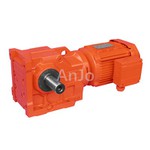
Servo Motor
Servo Motor
A servo motor is a high-precision closed-loop control motor that can accurately convert electrical signals into mechanical displacement (angular or linear displacement). It relies on a position feedback device (such as an encoder) to transmit the operating status to the controller in real time, forming a closed-loop control, thereby correcting deviations and achieving positioning accuracy, speed stability and dynamic response speed far exceeding those of ordinary motors. It is a core component for achieving precise control in automated equipment.
Features
- High control precision: Due to closed-loop control, servo motors do not accumulate errors and overcome the "step loss" problem of stepper motors, resulting in extremely high positioning accuracy.
- Good high-speed performance: Can operate stably at high speeds while providing rated torque.
- Strong overload capacity: Typically has 2-3 times the overload capacity, capable of withstanding instantaneous load impacts.
- Fast response speed: Extremely short reaction time from receiving a command to completing the action, resulting in excellent acceleration performance.
- Smooth operation: Operates smoothly even at low speeds, without the vibration phenomenon seen in stepper motors.
- Intelligent: Modern servo drives are powerful, supporting multiple control modes (position, speed, torque) and possessing rich self-diagnostic and protection functions.
Applications
Industrial robots:
Each joint of the robot requires a servo motor for precise position and speed control.
CNC machine tools:
Control the spindle and feed axes to achieve complex trajectory machining.
Semiconductor and electronics manufacturing:
Wafer handling, chip mounters, wire bonding machines.
Packaging machinery:
Achieve complex synchronous movements such as flying shears and label tracking.
Printing machinery:
Ensure precise synchronization in multi-color printing.
Automated production lines:
Precision assembly, inspection, and sorting stations.
FAQ
Q1: What three components must a servo system include?
A: It must include the following three integral components:
Servo motor: The actuator that outputs power.
Encoder: A feedback sensor that detects the motor's position and speed in real time; it's the "eyes."
Servo driver: The control brain that receives commands and feedback, and outputs control signals; it's the "brain."
These three components are indispensable and together constitute a complete servo system.
Q2: In what situations must I use a servo motor?
A: Servo motors should be considered first in any of the following situations:
High-precision positioning is required, and no cumulative error is acceptable.
High-speed operation is required, and a large output torque is still needed at high speeds.
Large load variations or impacts require strong overload capacity to overcome.
Extremely smooth motion is required, with no vibration or noise (such as in advanced CNC equipment).
Complex motion control is required, such as multi-axis synchronization, electronic cams, etc.
Q3: How do I choose the right servo motor for my equipment?
A: Selection is a systematic process, mainly considering:
Torque: Calculate the continuous operating torque and maximum instantaneous torque (acceleration torque) required by the load, and ensure they are both within the motor's rated and peak torque range.
Speed: Determine the maximum operating speed required by the load.
Inertia Matching: As mentioned above, calculate and match the load inertia.
Accuracy Requirements: Select an encoder with an appropriate resolution based on this.
Mounting Dimensions: Such as flange size, shaft diameter, length, etc.
Q4: Does a servo motor need tuning? What does tuning mainly include?
A: Yes, tuning is essential! Servo drive parameter tuning is crucial for achieving high performance. Tuning mainly includes:
Basic parameter settings: such as control mode (position/speed/torque), electronic gear ratio, enable signal, etc.
Gain adjustment: i.e., PID parameter tuning. By adjusting the proportional gain, integral gain, and derivative gain, the system achieves its optimal state of "fast response and stable, oscillation-free operation." Modern drives usually have automatic tuning functions.
Stiffness setting: Adjusts the system response speed. Higher stiffness results in a faster response, but excessive stiffness can lead to oscillation.
Q5: Q: What are some common alarms on servo drives? How do I handle them?
A: Common alarms and initial troubleshooting:
Overload alarm: Check if the load is too high, if there is any jamming, or if the acceleration time is too short.
Overvoltage/Undervoltage alarm: Check the mains voltage and whether the braking resistor is normal.
Encoder alarm: Check if the encoder cable is securely connected and if there are any breaks or interference.
Overcurrent alarm: Check if the motor phase wires are short-circuited, short-circuited to ground, or if the drive itself is faulty.
Troubleshooting: First, consult the alarm code descriptions in the drive manual, and then troubleshoot according to the instructions. Sometimes a power cycle can reset a momentary alarm, but the root cause must be found.

