


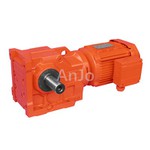


Shaft DC Motor
What is a Shaft DC Motor?
Shaft DC Motor is a permanent magnet brushed DC (PMDC) motor that relies on carbon brushes and a commutator for mechanical commutation, serving as mature, stable, low-voltage rotary power units. They utilize a permanent magnet stator to generate a fixed magnetic field and energize armature windings to produce torque; requiring only a DC power supply, they eliminate the need for position sensors or complex drive boards, allowing for stepless speed regulation via PWM voltage control.
When developing intermittent automation mechanisms, automotive auxiliary equipment, or small actuators, engineers often face constraints regarding budgets and development timelines, alongside a need for simplified control circuitry. Compared to brushless DC motors, brushed DC motor drive solutions are simpler, controller procurement costs are lower, and the workload for hardware debugging is reduced. Furthermore, they offer high starting torque and excellent low-speed load-bearing capabilities, making them ideal for equipment requiring intermittent operation and frequent start-stop cycles.


-
Simplified control scheme, shortened development cycle
Operates on direct DC power with PWM-based voltage and speed regulation; reversing direction simply requires swapping two power leads. It eliminates the need for Hall sensors or specialized brushless motor drivers, simplifying electronic control board design and facilitating both rapid prototyping and mass production.
-
High starting torque, stable performance under load at low speeds
The permanent magnet structure delivers high torque even at zero speed, ensuring smooth starts under heavy loads without stalling. It is ideal for equipment requiring direct, loaded startups from a standstill, such as gates, lifting mechanisms, and conveyor rollers.
-
Cost-effective system solution, convenient spare part replacement
Both the motor unit and its associated drive components are low-cost. Carbon brushes are independent, easily replaceable wear parts; maintenance involves only replacing the brushes rather than the entire motor, resulting in lower long-term operating and maintenance costs.

|
Model |
Micro DC Motor |
|
Type |
Round, Square type |
|
Power |
15W~1000W |
|
Input speed |
1600rpm, 2000rpm, 2500rpm, 3000rpm |
|
Ratio |
5~200 |
|
Motor diamter |
61~104 |
|
Current |
0.42~2.1A |
|
Motor voltage |
12V, 24V, 48V |


Q1: What is the typical service life of carbon brushes in permanent magnet brushed DC motors, and what factors shorten their lifespan?
A1: Under standard intermittent operating conditions, the service life of carbon brushes is approximately 2,000 to 5,000 hours. Their lifespan is most significantly affected by operating current, rotational speed, humidity, and dust. Continuous operation at full current and high speeds, as well as dusty environments, will significantly accelerate brush wear. We can estimate the replacement interval based on your specific duty cycle.
Q2: Can sparks from a brushed DC motor interfere with equipment sensors?
A2: Sparking caused by carbon brush commutation generates a certain level of electromagnetic interference. If precision sensors or circuit boards for weak signal acquisition are located nearby, it is recommended to use filtering capacitors and shielded cables, and to ensure proper grounding. If EMC requirements are extremely strict, switching to a brushless DC motor is recommended.
Q3: Can a brushed DC motor be connected directly to a DC power supply without a speed controller?
A3: Yes. If connected directly to the rated DC voltage, the motor will run at its rated speed; however, speed control is not possible, and there will be a high inrush current upon startup. To enable speed control and current-limiting protection, it is recommended to use a PWM DC speed controller.
Hot Tags: shaft dc motor, China shaft dc motor manufacturers, suppliers, factory
Previous
Low Rpm DC MotorYou Might Also Like


Send Inquiry