


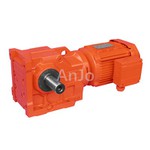


Brushless Direct Current Motor
What is a Brushless Direct Current Motor?
A brushless DC motor (BLDC) is a type of synchronous motor that utilizes an electronic controller for commutation. Its basic structure consists of a permanent-magnet rotor and a stator with multi-phase windings. During operation, the rotor position is detected-either via built-in Hall sensors or sensorless algorithms-allowing the drive circuitry to precisely control the current phase sequence; this generates a continuous rotating magnetic field that drives the rotor's rotation.
Compared to brushed motors, the fundamental difference lies in the elimination of physical brushes and commutators. This change yields two key advantages: first, it eliminates friction losses and sparking interference; second, it extends the motor's theoretical lifespan to over 20,000 hours-several times that of a brushed motor.


High Efficiency and Energy Savings: Overall Efficiency Improved by 20%–60%
Brushless DC motors feature a flat efficiency curve, with a typical efficiency range of 85%–92%; peak efficiency in some optimized designs even exceeds 92%. These motors maintain high efficiency even under low-load conditions-a critical advantage for equipment requiring prolonged, continuous operation, such as fans and pumps. Empirical data shows that, compared to traditional brushed motor solutions, brushless motors can achieve overall energy savings of 20%–60%.
Precision Speed Control: Speed error of less than 1%
Brushless DC motors support smooth speed regulation across a wide range-from a few revolutions per minute to several thousand-with speed stability errors typically below 1%. When combined with PWM speed control or Field-Oriented Control (FOC) technology, they enable precision control with torque ripple of less than 1%, meeting the requirements of diverse applications.
Long Service Life and High Reliability: No Frictional Wear
Friction from carbon brushes is the primary factor limiting the lifespan of brushed motors. Because brushless motors lack mechanical contact, their core components can achieve a lifespan of 10,000 to 30,000 hours, significantly extending maintenance intervals. Furthermore, electronic commutation eliminates sparking, enabling the motors to be used in applications with strict EMC (Electromagnetic Compatibility) requirements, such as medical instruments and communication equipment.


Q: How is brushless motor speed control achieved?
A: The rotational speed can be smoothly adjusted by varying the duty cycle of the input PWM (Pulse Width Modulation) signal. By incorporating an encoder or Hall sensor, high-precision closed-loop speed control and position control can also be achieved.
Q: Do brushless motors require regular maintenance?
A: They are essentially maintenance-free. Since there is no wear from carbon brushes, the primary maintenance involves only the periodic inspection and replacement of bearings, resulting in very low maintenance costs.
Q: What are the main differences between brushless DC motors and brushed motors?
A: Brushless motors utilize electronic commutation and lack physical brushes; consequently, they offer a longer lifespan (typically 3–10 times that of brushed motors), higher efficiency (exceeding 90%), and lower noise levels, while also eliminating spark interference.
|
|
|
|
|
|
|
|
|
|
|
|
|
|
|
|
|
|
|
|
|
|
|
|



Hot Tags: brushless direct current motor, China brushless direct current motor manufacturers, suppliers, factory
Previous
Bldc Dc MotorYou Might Also Like


Send Inquiry