


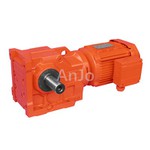


Mini Servo Motor
What are Mini Servo Motors?
Servo motors serve as the core precision drive components for high-end automation equipment. Unlike standard three-phase asynchronous motors-which typically operate at fixed speeds-or DC motors, which offer controllable speed regulation, servo motors excel in precision positioning, angular control, closed-loop speed control, and real-time adaptive torque management. They are the only class of industrial motors capable of executing intelligent operations with precise control over position, angle, speed, and torque. This series consists of permanent magnet synchronous AC servo motors developed in strict accordance with the GB/T 30544 and IEC 61800 international standards for variable-speed drive systems; they effectively resolve critical issues in precision equipment such as positioning errors, start-stop jitter, high-speed drift, load displacement, and poor synchronization.


1. Full closed-loop real-time feedback with micron-level precision positioning.
Equipped with an ultra-high-resolution 24-bit optical encoder, the system achieves real-time closed-loop feedback across position, velocity, and torque. It dynamically corrects deviations within milliseconds, effectively eliminating issues such as inertial drift, load shifting, and cumulative errors. The unit delivers a repeatability of ±0.01 mm and minimal angular control error, completely resolving common stepper motor problems-such as missed steps, positioning inaccuracies, and precision degradation at high speeds-making it ideally suited for demanding applications like CNC machining, precision cutting, and high-precision bonding.
2. Ultra-fast dynamic response; handles high-frequency start-stop operations with ease.
Featuring a lightweight rotor design and precise inertia matching, the motor delivers torque response speeds far superior to conventional motors. It supports high-frequency start-stop cycles, instantaneous acceleration and deceleration, and rapid switching between forward and reverse rotation, making it ideal for the high-frequency cyclic operations of automation equipment. With shock-free starts and stops and lag-free speed changes, it is perfectly suited for high-efficiency production scenarios-such as high-speed assembly line sorting, rapid robotic arm positioning, and reciprocating conveyance-significantly boosting operational throughput and production efficiency.
3. Adaptive load compensation ensures no deviation or stalling under heavy loads.
Equipped with an intelligent torque-adaptive algorithm, the system senses real-time changes in load and automatically and dynamically compensates for torque and speed. It maintains stability at high speeds under light loads and delivers ample power under heavy loads; it prevents issues such as speed drops, positioning errors, or stalling-even when facing sudden load fluctuations, material weight variations, or changes in equipment resistance-offering superior interference resistance and operational adaptability compared to standard fixed-speed or variable-speed motors.

|
Item |
Specifications |
|
Type |
AC Servo Motor, DC Servo Motor |
|
Voltage |
DC24V/48V,AC220V/380V
|
|
Rated Speed |
1800rpm~6000rpm |
| Positioning accuracy |
±0.01°
|
| Overload capacity | Short-term overload of 3 times rated torque (suitable for impact loads) |
|
Frequency |
50HZ, 60HZ |
|
Method |
RS485,CANopen,EtherCAT
|
|
Power |
100W / 200W / 300W / 400W/1000W
|
| Encoder Configuration | Optional 2500-line incremental or 17-bit absolute encoder |
|
Class of Protection |
IP65 |


Q1: What are the key differences between servo motors and standard DC or three-phase motors?
A1: Common causes of issues include inertia mismatch, load overload, improper acceleration/deceleration parameters, encoder contamination or wiring interference, and excessive mechanical backlash. This series of servo motors undergoes precision calibration and inertia matching at the factory, resulting in virtually zero deviation under normal operating conditions; should deviations occur, the recommended first steps are to adjust drive parameters and inspect the mechanical structure, and the manufacturer offers free guidance on parameter optimization.
Q2: How do you choose between servo motors and stepper motors?
A2: Stepper motors are suitable for applications involving low speeds, slow cycle times, standard positioning requirements, and limited budgets. Servo motors are the preferred choice for automated production lines requiring high speeds, frequent start-stop cycles, high-precision positioning, the ability to handle significant load fluctuations, and real-time error correction. Servo motors offer advantages such as no step loss, higher precision, faster dynamic response, and superior long-term operational stability, making them ideal for high-end smart manufacturing applications.
Q3: What causes positioning deviation in servo motor operation?
A3: Common causes include inertia mismatch, load overload, unreasonable acceleration/deceleration parameters, encoder contamination or wiring interference, and excessive mechanical backlash. This series of servo motors undergoes precision calibration and inertia matching at the factory, resulting in virtually zero deviation under normal operating conditions; if deviation occurs, priority should be given to adjusting drive parameters and inspecting the mechanical structure, and the manufacturer can provide free guidance on parameter optimization.
|
|
|
|
|
|
|
|
|
|
|
|
|
|
|
|
|
|
|
|
|
|
|
|



Hot Tags: mini servo motor, China mini servo motor manufacturers, suppliers, factory
Previous
Small Servo MotorYou Might Also Like


Send Inquiry