


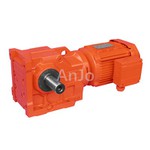


High Precision Servo Motor
What is a High Precision Servo Motor?
Designed for automation equipment with rigorous requirements for trajectory control, repeatable positioning, and smooth low-speed operation, these high-precision AC permanent-magnet servo motors leverage optimized sinusoidal magnetic circuits and high-resolution absolute encoders for full closed-loop feedback. They enable precise, controllable performance across position, velocity, and torque modes. Unlike standard general-purpose servos, this series is engineered to minimize cogging torque and torque ripple, ensuring jitter-free low-speed operation and controlled commutation errors. Supporting mainstream control interfaces-such as EtherCAT and pulse-direction-the motors are available in low, medium, and high-inertia versions, with optional features including power-off electromagnetic brakes, oil seals, and cooling fans. Ideally suited for multi-axis synchronization, continuous trajectory interpolation, and micron-level point-to-point positioning, these motors serve as the core actuators for achieving stable, high-precision motion control in CNC machinery, semiconductor manufacturing, precision inspection systems, and high-speed packaging equipment.


1. Low-cogging-torque design for smooth, jitter-free low-speed operation
By utilizing an optimized configuration of skewed magnets and sinusoidal windings, torque ripple is minimized. This ensures minimal speed fluctuation during low-speed, micro-feed operations, effectively preventing issues such as "stick-slip" (jerky motion) or micro-vibrations in inspection platforms and engraving spindles.
2. High-resolution absolute encoder with power-off position retention
Equipped with a multi-turn absolute encoder as standard, the system eliminates the need for a "homing" (return-to-origin) procedure upon power-up, as coordinate data is retained even after power loss. High-resolution feedback significantly enhances repeatability, streamlines operation by removing the need for homing cycles, and increases overall equipment utilization.
3. Multiple inertia options to suit diverse load characteristics
Low-inertia models offer rapid response and short start-stop cycles, making them ideal for high-speed sorting, component placement, and short-stroke reciprocating mechanisms. Medium-to-high-inertia models provide superior resistance to load disturbances, making them well-suited for heavy-duty linear stages, CNC spindles, and rotary tooling fixtures.

|
Item |
Specifications |
|
Type |
AC Servo Motor |
|
Voltage |
AC220V/380V
|
|
Rated Speed |
1800rpm~6000rpm |
| Positioning accuracy |
±0.01°
|
| Overload capacity | Short-term overload of 3 times rated torque (suitable for impact loads) |
|
Frequency |
50HZ, 60HZ |
|
Method |
RS485,CANopen,EtherCAT
|
|
Power |
100W / 200W / 300W / 400W/1000W
|
| Encoder Configuration | Optional 2500-line incremental or 17-bit absolute encoder |
|
Class of Protection |
IP65 |


Q1: What is the core difference between high-precision servo motors and standard servo motors?
A1: The primary differences lie in magnetic circuit design and feedback components. High-precision versions focus on minimizing cogging torque and torque ripple; when paired with higher-resolution encoders, they exhibit significantly less fluctuation during low-speed micro-feeding or path interpolation. In contrast, standard servo motors prioritize stable power output, with less stringent requirements for low-speed smoothness or path-following accuracy.
Q2: Do absolute encoders never require a return to the home position?
A2: With a multi-turn absolute encoder, the position is not lost during a normal power-off; the coordinates can be read directly upon power-up. However, in the event of a depleted battery, an encoder malfunction, or a mechanical disconnection, the home position must still be re-calibrated.
Q3: What are the typical areas to investigate when a servo motor exhibits jitter at low speeds?
A3: First, check for inertia mismatch or excessively high drive gain parameters. Next, examine the system for mechanical backlash, sticking or binding in the guide rails, and coaxial misalignment in the couplings. Finally, verify that the encoder wiring is properly shielded and that the grounding is correctly implemented.
|
|
|
|
|
|
|
|
|
|
|
|
|
|
|
|
|
|
|
|
|
|
|
|



Hot Tags: high precision servo motor, China high precision servo motor manufacturers, suppliers, factory
Previous
Small Brushed MotorYou Might Also Like


Send Inquiry