


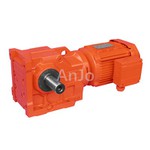


Gear Box Coupling
What is the Gear Box Coupling?
Gearbox couplings are universal transmission components used in gear-driven reduction systems to connect gearboxes, drive motors, and the shafts of driven loads, serving as critical transitional elements within the entire drive train. Depending on operational requirements, they are categorized into types such as rigid-adjustable, flexible-compensating, and overload-safety couplings. Common designs include gear couplings (with crowned teeth), serpentine spring couplings, diaphragm (disc) couplings, jaw (spider) couplings, tire couplings, roller chain couplings, and locking assemblies. These various types perform functions such as torque transmission, compensation for installation misalignment, vibration damping, overload protection, and electrical isolation. They are suitable for a wide range of applications-from precision, light-load conveying systems to heavy-duty, high-torque gearbox operations in sectors like mining, industrial mixing, and construction materials.
Models


Features
1. Accommodating shaft misalignment and protecting core internal gearbox components
A properly selected coupling can compensate for radial, angular, and axial installation errors, as well as shaft misalignment caused by thermal expansion/contraction or structural settling. This reduces additional loads on gears and bearings, thereby extending the service life of the gearbox.
2. Dampening vibrations and isolating shock loads
Flexible couplings can absorb shocks and vibrations resulting from start-stop cycles or material jams. They prevent the transmission of vibrations between the motor, gearbox, and load, which helps reduce operational noise and the risk of fatigue-related damage.
3. Standardized interfaces with high interchangeability
Shaft bores, flanges, and keyways adhere to universal mechanical transmission standards. Most specifications are directly compatible with spare parts from overseas brands, meaning that shaft ends typically do not require re-machining when retrofitting or replacing a gearbox.
Application


Company Profile




FAQ
Q1: Should you choose a flexible or a rigid coupling for a gearbox?
A1: Neither is inherently better; the choice depends on the application. For scenarios requiring shock absorption, vibration damping, low maintenance, or handling small-to-medium torque, opt for a flexible coupling. For applications involving high torque, high-precision synchronization, or continuous heavy-duty loads, select a metallic flexible coupling-such as a gear coupling or a grid (serpentine spring) coupling.
Q2: Can couplings of different designs but the same torque rating be directly interchanged?
A2: No. Even if the rated torque is identical, differences in compensation capacity, allowable rotational speed, moment of inertia, and axial dimensions mean that a direct replacement could lead to issues such as resonance, mechanical interference, or inadequate alignment. A re-evaluation is required.
Q3: Do couplings that use locking assemblies (shrink discs/locking collars) cause damage to gearbox shafts?
A3: When installed correctly and tightened to the specified torque, they do not damage the shaft surface. Unlike keyed connections, they eliminate stress concentrations caused by keyways, are less prone to "key-rolling" (deformation or slippage of the key/keyway) under cyclic loading, and are also more convenient to assemble and disassemble.
|
|
|
|
|
|
|
|
|
|
|
|
|
|
|
|
|
|
|
|
|
|
|
|



Hot Tags: gear box coupling, China gear box coupling manufacturers, suppliers, factory
You Might Also Like




Send Inquiry