


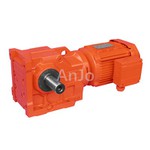


Two Stage Planetary Gearbox
What is a Two Stage Planetary Gearbox?
The two-stage planetary gearbox is a coaxial, modular power transmission unit (comparable to the P2N series). It features two sets of planetary gear modules arranged in series, utilizing a multi-planet load-sharing principle to achieve a moderate gear ratio and high torque output within a compact, coaxial design. The housing is cast from high-toughness ductile iron, and the unit employs hardened, helical-toothed gears-a configuration that balances transmission efficiency, torsional rigidity, and thermal stability. With a coaxial input and output arrangement, it can be directly coupled with three-phase asynchronous motors or hydraulic motors, and supports various mounting configurations, including base, flange, and torque-arm options. Compared to three-stage planetary gearboxes, this two-stage design offers lower thermal loss, higher transmission efficiency, and superior backlash control, making it a primary choice for heavy-duty applications such as conveying, mixing, and feeding. Unlike small-scale precision planetary gearboxes designed for servo-driven, micron-level positioning, this unit is engineered for continuous, shock-loaded environments, with a primary focus on long-term, stable load-bearing capacity.
Models


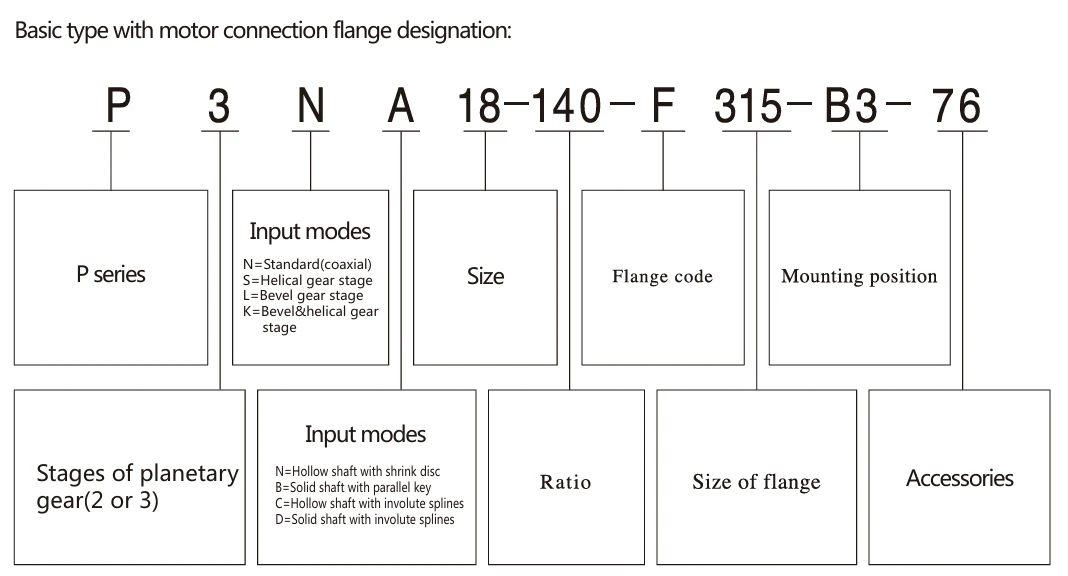
Types: P2N,P2L,P2S,P2K,P3N,P3S,P3K
Features
1. High efficiency with controllable temperature rise; suitable for long-term, continuous operation.
Featuring only two stages of transmission, the unit offers significantly lower power loss compared to three-stage planetary systems and superior thermal capacity. During continuous daily operation (8–24 hours), the housing maintains a lower temperature rise, which slows the aging of the lubricating oil and reduces the risk of high-temperature failure for oil seals and bearings.
2. Helical gear load-sharing structure; resistant to cyclic impact loads.
The sun gear, planetary gears, and internal ring gear are all manufactured from alloy steel-carburized, quenched, and precision-ground with a helical profile. This design ensures a high contact ratio and uniform load distribution across multiple planetary gears, allowing the system to withstand periodic impacts caused by material jams or frequent start-stop cycles, while providing excellent resistance to pitting fatigue on the tooth surfaces.
3. Robust, one-piece ductile iron housing; high rigidity and resistance to deformation.
The QT-series ductile iron housing undergoes stress-relief aging treatment, ensuring minimal deformation under heavy loads. This maintains precise gear meshing alignment and prevents uneven wear caused by off-center loading, making it well-suited for the demanding, high-load environments found in mining, environmental protection, and feed processing facilities.
Products Description

Specifications



Our advantages


Company Profile


Product Range:
Gear reducers, worm gear reducers, and electric motors, etc.
Core Advantages
Customized production, extensive export experience;
Service Scope:
Integrated product export, technical support, and after-sales guarantee.

FAQ
Q1: How should one choose between a two-stage and a three-stage heavy-duty planetary gearbox?
A1: Prioritize the two-stage version. It offers higher efficiency, generates less heat, and is more cost-effective, making it suitable for medium gear ratios in the 25–40 range. A three-stage version should only be selected when a higher gear ratio or an extremely low output speed is required-cases where a two-stage unit cannot meet the specifications. The trade-offs for choosing a three-stage unit are lower efficiency and increased heat loss.
Q2: Is it better to install a backstop on the high-speed side or the low-speed side?
A: For heavy-duty applications, it is preferable to install the backstop on the low-speed side, as it is subject to lower forces and offers a longer service life. While a backstop on the high-speed side is more compact, it is more susceptible to damage to its internal components from impact loads, making it better suited for light-duty applications.
Q3: Can a two-stage heavy-duty planetary gearbox undergo frequent forward and reverse rotation?
A3: It supports bidirectional operation; however, high-frequency reversing generates alternating impact loads, which accelerate fatigue in gears and bearings. For applications involving frequent reversing, it is recommended to increase the service factor, reduce the acceleration during reversal, and minimize impacts on the gear tooth surfaces.
|
|
|
|
|
|
|
|
|
|
|
|
|
|
|
|
|
|
|
|
|
|
|
|



Hot Tags: two stage planetary gearbox, China two stage planetary gearbox manufacturers, suppliers, factory
Previous
Cycloid MotorYou Might Also Like


Send Inquiry